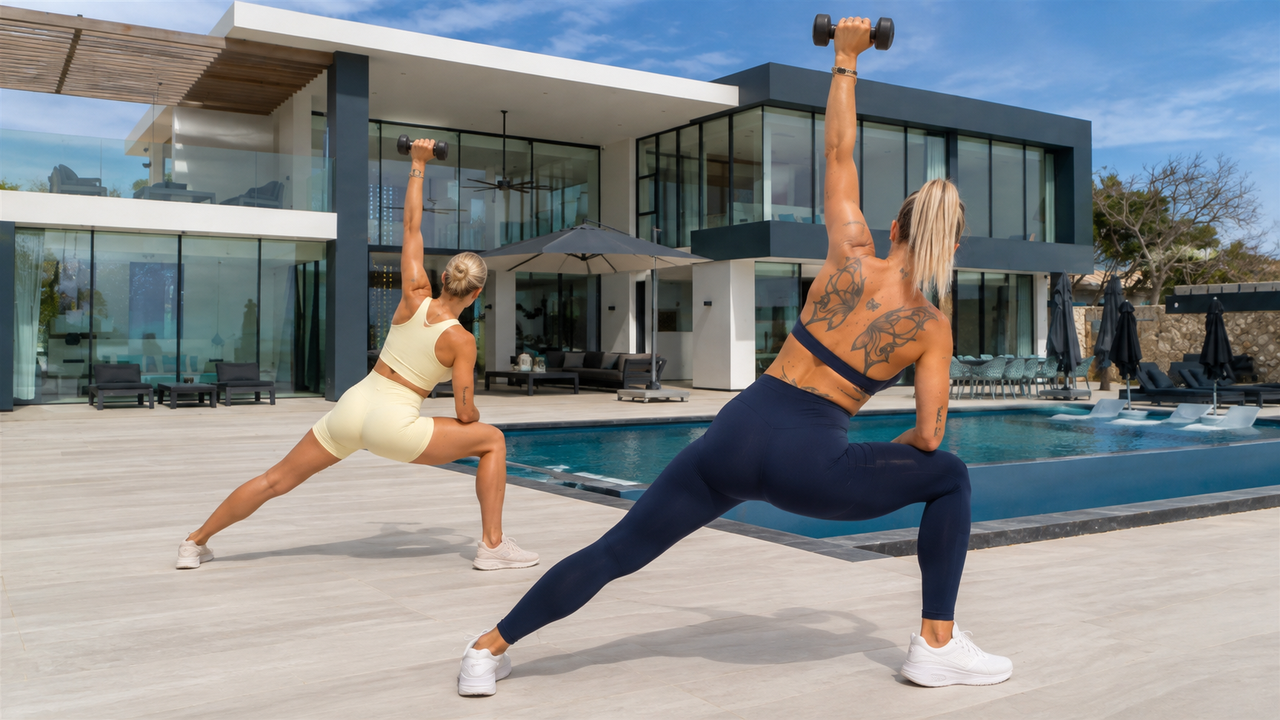
There is no single “perfect” exercise program.
Two people can perform the same exercises, follow the same schedule and receive the same instructions — and still experience training very differently.
One may need more load.
Another may need more control.
One may feel challenged by balance.
Another may be strong but unfamiliar with the movement.
That does not mean one person is doing it wrong.
It means exercise happens in a real human body, not on a spreadsheet.
The same program does not produce the same experience for everyone
Research consistently shows that people can respond differently to the same exercise intervention.
Scientists sometimes describe this as interindividual variability: differences between individuals in how they respond to training.
That does not mean we should label people too quickly as “responders” or “non-responders.” Researchers have pointed out that measurement error, day-to-day variation and statistical methods can make those categories much more complicated than they appear.
But the practical message is simple:
People do not arrive at training with identical bodies, histories, abilities or goals.
A program that makes sense for one person may require adjustment for another.
Individualization is not the same as making every session completely different
Personalized training does not mean randomly changing exercises every time.
Good individualization is much more structured than that.
It can mean adjusting:
- exercise selection
- range of motion
- resistance
- repetitions
- tempo
- rest periods
- complexity
- total training volume
- the amount of coaching or feedback needed
The underlying goal may remain the same, while the way we reach it changes.
For example, two people may both be working on lower-body strength.
One might benefit from a bodyweight squat while learning control and positioning.
Another may need external resistance through dumbbells or a kettlebell.
The objective is similar.
The appropriate challenge is not.
Your capacity can also change from one day to another
Individualization is not only about differences between people.
It is also about changes within the same person.
Sleep, stress, previous training, recovery and general readiness can affect how a session feels on a particular day.
Resistance-training researchers have studied this idea through autoregulation — adjusting aspects of training according to current performance rather than following a completely fixed prescription.
The evidence does not show that autoregulated training is magically superior in every situation. Research comparing autoregulated and standardized approaches has found broadly similar strength improvements overall.
What it does illustrate is an important coaching principle:
A useful program can have structure without being rigid.
Supervision can matter — but context matters too
Private training also provides something a written program cannot: immediate observation and feedback.
Research comparing supervised and unsupervised resistance training has found some advantages for supervision in certain performance outcomes, particularly strength, while differences in body-composition outcomes appear much less clear.
That distinction matters.
Supervision is not a shortcut that guarantees transformation.
Its value may come from things such as:
- helping someone select an appropriate challenge
- adjusting technique
- progressing exercises when appropriate
- reducing unnecessary complexity
- keeping the session aligned with the person’s actual goal
And for some experienced exercisers, independent training works extremely well.
Private coaching is an option — not a requirement for everyone.
More personalized does not automatically mean more complicated
There is a tendency in fitness to equate sophistication with effectiveness.
More exercises.
More equipment.
More data.
More variation.
But personalization can sometimes mean doing less.
Removing an exercise that does not serve the goal.
Repeating a movement long enough to learn it.
Using a lighter resistance so control improves.
Using a heavier resistance when the current one is no longer challenging.
Taking more rest.
Or simply choosing the version of an exercise that allows someone to train well today.
A personalized program should become clearer — not more confusing.
This is where private training can be useful
A private session creates room to observe the person rather than simply deliver a predetermined class.
That can be particularly useful when someone:
- is completely new to exercise
- wants more feedback
- has a specific goal
- feels unsure about technique
- prefers a quieter environment
- wants training adapted around other activities
- simply enjoys one-to-one coaching
It also gives the coach more freedom to choose between different tools.
Pilates can be useful.
Strength training can be useful.
Mobility work can be useful.
Kettlebells, dumbbells, resistance bands, a Pilates ring or simply bodyweight can all be useful.
The method should serve the person — not the other way around.
Private training is not automatically better than group training
This distinction is important.
A good group class can be motivating, enjoyable and extremely effective.
Some people prefer the energy of training with others.
Some are experienced enough to adapt exercises independently.
And some simply do not need one-to-one attention.
There is no reason to pretend that private training is universally superior.
Its advantage is different:
It creates more opportunity to make decisions around one person at a time.
Whether that extra individualization is valuable depends on the person.
What personalized training looks like in practice
Imagine two people arriving for the same type of session.
Both want to become stronger and move better.
The first has exercised for years but has never used Pilates-style control work.
The second is completely new to structured exercise.
Giving both people the exact same repetitions, resistance and progression simply because they booked the same service would make little sense.
Instead, the session can begin with the same broad goal while adapting the route.
One person may need more resistance.
The other may need more time learning the movement.
As they progress, those decisions can change.
That is individualization.
Not a secret method.
Not a “perfect” routine.
Just better decision-making.
How I approach it at Nika
At Nika, I do not see Pilates, resistance training, mobility or conditioning as competing systems.
They are tools.
My background across Pilates, functional training, HIIT, circuit training and physical conditioning allows me to choose from different approaches depending on the person in front of me.
Some sessions may stay almost entirely within Pilates.
Others may include resistance bands, dumbbells, kettlebells, a ball or a Pilates ring when available and appropriate.
The aim is not to make the session look impressive.
The aim is to make the session make sense.
The bottom line
Good training needs enough structure to create progress.
It also needs enough flexibility to respond to the person doing it.
A one-size-fits-all program can work well for many people.
But when goals, experience, preferences or abilities differ, individualization gives us another option:
Keep the goal — adjust the path.
Scientific references & further reading
Fisher JP, Steele J, Wolf M, Androulakis-Korakakis P, Smith D, Giessing J. (2022). The Role of Supervision in Resistance Training; an Exploratory Systematic Review and Meta-Analysis. International Journal of Strength and Conditioning.
Hickmott LM, Chilibeck PD, Shaw KA, Butcher SJ. (2022). The Effect of Load and Volume Autoregulation on Muscular Strength and Hypertrophy: A Systematic Review and Meta-Analysis. Sports Medicine - Open.
Bonafiglia JT, Preobrazenski N, Gurd BJ. (2021). A Systematic Review Examining the Approaches Used to Estimate Interindividual Differences in Trainability and Classify Individual Responses to Exercise Training. Frontiers in Physiology.