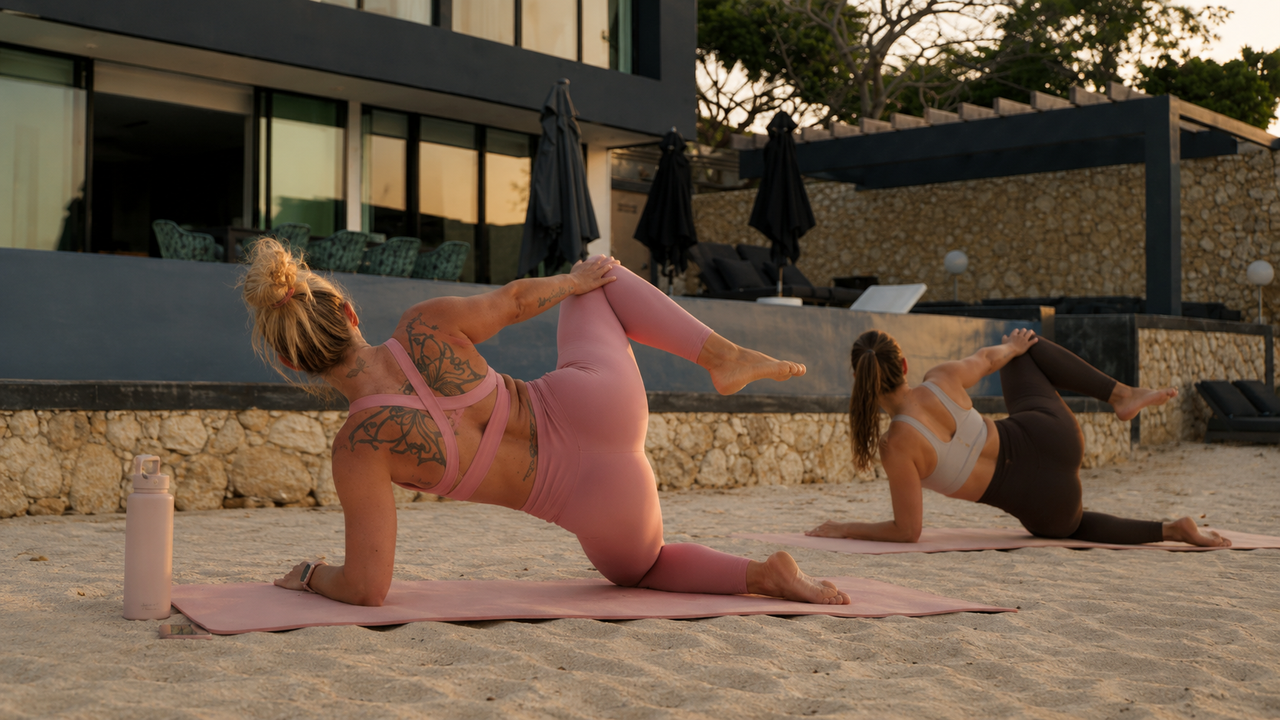
Training in Bonaire feels different.
The island is warm throughout the year, the sun is strong, and the trade winds are part of everyday life. You can move outdoors almost any day of the year — but that does not mean every day should be approached in exactly the same way.
The environment changes how exercise feels.
And sometimes, it changes what makes sense to do.
Whether you live here or you have just arrived for a week of diving, swimming and exploring, the goal is not to fight the climate.
It is to work with it.
The fundamentals do not change — but the environment does
Your muscles still respond to resistance.
Your cardiovascular system still responds to demand.
Progress still depends on appropriate training, recovery and consistency.
But exercise in a hot environment creates additional work for the body because it must support both movement and temperature regulation.
As body temperature rises, more blood is directed toward the skin to help release heat. Sweating increases. Heart rate can climb even when the actual mechanical workload has not changed.
This is one reason a familiar workout can suddenly feel harder outdoors in Bonaire than it does in an air-conditioned room.
It does not necessarily mean your fitness disappeared on the flight here.
The environment changed.
A higher heart rate does not always mean you should push harder
If you normally use heart rate to guide your workouts, heat adds an important complication.
During prolonged exercise in warm conditions, heart rate can gradually rise even when pace or workload stays the same. Exercise physiologists refer to part of this response as cardiovascular drift.
That means chasing the same heart-rate targets you use in cooler conditions is not always helpful.
Your perception of effort matters too.
If your usual walking pace suddenly feels significantly harder, your breathing is less comfortable or you feel unusually drained, slowing down is not “losing the workout.”
It is adjusting the workout to the conditions you are actually training in.
Bonaire’s wind helps — but it does not cancel the heat
The trade winds are one of the things that make movement outdoors here so enjoyable.
Moving air can improve heat loss and make exercise feel noticeably more comfortable.
But feeling cooler does not mean you are no longer sweating or losing fluid.
In fact, when sweat evaporates quickly, you may notice it less than you would in a still environment.
The practical lesson is simple:
Enjoy the wind, but do not use “I don’t feel sweaty” as your only measure of how much heat or fluid loss your body is managing.
Hydration is individual
There is no perfect number of liters that every person needs during exercise.
Sweat rates differ considerably between people and can change with temperature, exercise intensity, clothing, body size and heat acclimatization.
For shorter, lower-intensity sessions, drinking according to thirst may be perfectly reasonable for many healthy people.
Longer, harder sessions in the heat are different. When sweat losses become substantial, a more deliberate hydration strategy can become useful.
And more is not automatically better.
Drinking excessive amounts of plain water simply because you are exercising in the Caribbean is not the goal either.
The aim is to arrive reasonably hydrated, have fluid available when appropriate, and replace meaningful losses without turning hydration into another extreme fitness rule.
For prolonged or particularly sweaty sessions, fluids containing electrolytes may also be useful.
The time of day can change the entire session
A workout does not have to happen at the hardest possible time of day to count.
In Bonaire, moving earlier in the morning or later in the afternoon can substantially change how comfortable an outdoor session feels.
That may allow you to perform better, enjoy the session more and recover more easily afterward.
This matters especially when the workout is only one part of an active day.
If you are also planning to dive, snorkel, windsurf, walk around the island or spend hours in the sun, your training session does not exist in isolation.
All of that activity contributes to the day’s total physical demand.
Sometimes the smart choice is not removing training.
It is changing its timing or intensity.
Just arrived? Give your body time to adapt
Someone who lives and trains in Bonaire regularly does not experience the environment exactly like someone who arrived yesterday from a cooler climate.
Repeated heat exposure can produce physiological adaptations that make exercise in the heat easier to tolerate.
These adaptations do not happen instantly.
Research on heat acclimatization shows meaningful changes developing over repeated exposures across several days.
So if you have just arrived, your first outdoor workout is not the moment to prove that you can maintain exactly the same pace, duration and intensity you use at home.
Start with the environment you have today.
Then adapt.
You do not need to turn every island day into a workout
Bonaire makes being active unusually easy.
You might swim before breakfast, carry dive equipment, walk along the coast, spend an afternoon snorkeling and still think:
“I didn’t train today.”
But physical stress does not care whether an activity appeared in your workout app.
Movement outside the gym still counts toward your total workload.
This becomes especially relevant for visitors trying to fit their normal training schedule around an already active vacation.
Sometimes maintaining your routine makes sense.
Sometimes reducing volume does.
And sometimes twenty or thirty minutes of mobility, controlled strength work or Pilates is a better complement to the day than another demanding conditioning session.
What about training and diving?
Bonaire deserves a special note here because diving is part of everyday life for many residents and visitors.
Being physically fit is valuable for diving, but intense exercise and diving are not always ideal back-to-back activities.
Diving research has raised concerns about vigorous exercise too close to a dive because of its potential relationship with decompression stress.
That does not mean a dive day requires complete inactivity.
It means the timing and intensity of exercise deserve consideration.
If your day includes multiple dives, a gentle mobility session, controlled Pilates practice or easy movement may make more sense than placing your hardest strength or conditioning session immediately around them.
When diving is the priority, your training can support the day instead of competing with it.
Train for the day you actually have
Imagine you planned a demanding lower-body workout.
But you slept poorly, completed two dives in the morning, spent several hours outside and arrive at the session already feeling tired.
You could force the original plan.
Or you could keep the purpose of the session while changing the path.
That might mean reducing resistance, decreasing total volume, choosing slower controlled movements or turning the session into mobility and recovery work.
The opposite can also happen.
You may arrive feeling rested, well hydrated and strong.
Then there may be no reason not to challenge yourself.
Adaptation does not mean always doing less.
It means making decisions using the information available that day.
How I adapt private sessions in Bonaire
The environment is one more piece of information I consider when planning a session.
If we are training outdoors, that can mean choosing shade, adjusting the pace, building in water breaks or modifying the session according to what the client has already done that day.
A visitor who has been diving all morning may need something very different from a resident beginning her day with a strength-focused session.
One person may benefit from Pilates and mobility.
Another may be ready for kettlebells, resistance bands or dumbbells.
The equipment or method is secondary.
The useful question is:
What kind of movement makes sense for this person, on this day, in this environment?
A simple way to think about outdoor training in Bonaire
Before starting, consider four things:
- Heat: Does today’s temperature and sun exposure change the intensity that makes sense?
- Hydration: Have you been drinking normally, and will you have access to fluid?
- Total activity: Are you also diving, swimming, hiking, cycling or spending several hours outdoors?
- Readiness: How do your energy, breathing, muscles and general effort feel today?
You do not need a complicated algorithm.
You need enough awareness to adjust when the situation calls for it.
The bottom line
Bonaire gives us an extraordinary environment for movement.
But training well here is not about ignoring the heat because you are used to it, or pushing through because you are only here for a week.
The principles of good training stay the same.
The context changes.
And good movement respects both.
Keep the goal. Read the environment. Adjust the path.
Scientific references & further reading
Périard JD, Eijsvogels TMH, Daanen HAM. (2021). Exercise under heat stress: thermoregulation, hydration, performance implications, and mitigation strategies. Physiological Reviews.
Brown HA et al. (2024). Quantifying Exercise Heat Acclimatisation in Athletes and Military Personnel: A Systematic Review and Meta-analysis. Sports Medicine.
Kenefick RW. (2018). Drinking Strategies: Planned Drinking Versus Drinking to Thirst. Sports Medicine.
Wingo JE. (2015). Exercise intensity prescription during heat stress: A brief review. Scandinavian Journal of Medicine & Science in Sports.
Junge N, Jørgensen R, Flouris AD, Nybo L. (2016). Prolonged self-paced exercise in the heat — environmental factors affecting performance. Temperature.